
UX / UI Design for UPS
Process Optimization for Last-Mile Delivery Services
Time
May. 2024-Aug. 2024
Duration
3 months
Project brief
UPS was the first express delivery company I used when I came to Germany. Due to the extremely poor experience, I decided to optimize UPS's last-mile delivery process. I redesigned the pages and interactions of the UPS app, added pickup codes, a new pickup flow, and improved the page for changing couriers. After testing, the new UPS app significantly improved the user experience for last-mile deliveries.
Role
UX/UI Designer, Usability Research
Team
Independent completion
Final outcome
60%+
Growth expected
(projected)
1100+
Daily users expected
(projected)
Since this project was my graduation project and had only three months to complete, the final result was not market-oriented. However, based on the data on the market, I expect the new version will increase 60% of positive user feedback and 1100+ users per day than the old version. Users will spend less time waiting for each parcel after using the new version, so they can better balance their life and waiting for parcels; they will have better choices when facing unexpected situations; and they can use the UPS app to do all the operations they want to do.

Main challenges
Poor IA

During the period between when I first had the idea of optimising the UPS and when I actually started working on the project, the UPS app underwent an upgrade. Although the upgraded information architecture was relatively more logical than the previous one, there were still many problems that did not make sense during use. For example, the content of parcel information cards and the priority of information. Therefore I reorganised and redesigned the information architecture.
Lack of interface

The page for change delivery is missing from the UPS app. Users need to use the linked website in the E-mail to do this. This results in the user needing to switch between the App, E-mail, and webpage to complete the change delivery action. This is a burden for the user, especially for those who are not good with mobile phones and IoT. So I consolidated the change delivery process and designed new pages to add to the APP.
Don't understand users

I don't understand the behavioural habits of Germans in the process of online shopping and sending and receiving couriers. Because I had only been in Germany for half a year when I did this project, I didn't know much about the daily life habits of Germans. So the whole project was still a big challenge for me. Afterwards, in order to solve this problem, I conducted a quick survey with my German friends. And I used quantitative research and stereotypical research in the design process to help me understand the behavioural habits of Germans.
Goals
To address the existing problems, by optimising the interaction process of UPS's APP, the user's experience in the last-mile delivery will be enhanced, thus strengthening the competitiveness of the product and increasing user stickiness.
Understand the problem
User research
In the user research phase, I conducted both quantitative and qualitative research. The aim was to understand the behavioural habits and pain points of Germans in last mile delivery. In the quantitative study, a total of 104 people completed the questionnaire. In the qualitative study, I used semi-structured interviews to interview 6 people, 3 Germans and 3 Chinese living in Germany. Because China has rich experience in last mile delivery, three Chinese people living in Germany were chosen to compare the difference between China and Germany from another perspective and to provide some lessons that can be learnt.

Pain point 1
No one was home at the time of the UPS delivery. UPS deliverers do not go upstairs to make deliveries and directly drop off cards where no one is home.
Pain point 2
Users who are in a hurry to use their parcels have to wait until the next working day for delivery because the delivery efficiency is too slow, which affects their life, work, and study.
Pain point 3
Changing the time and place of delivery requires a web page to complete the operation, which makes delivery cumbersome.
Persona
Based on the results of the user testing, the users were categorised into two types and two Persona's were drawn. this will help me to be more aware of what the users really want and clarify what should be done in the design process afterwards.


Competitor Analysis
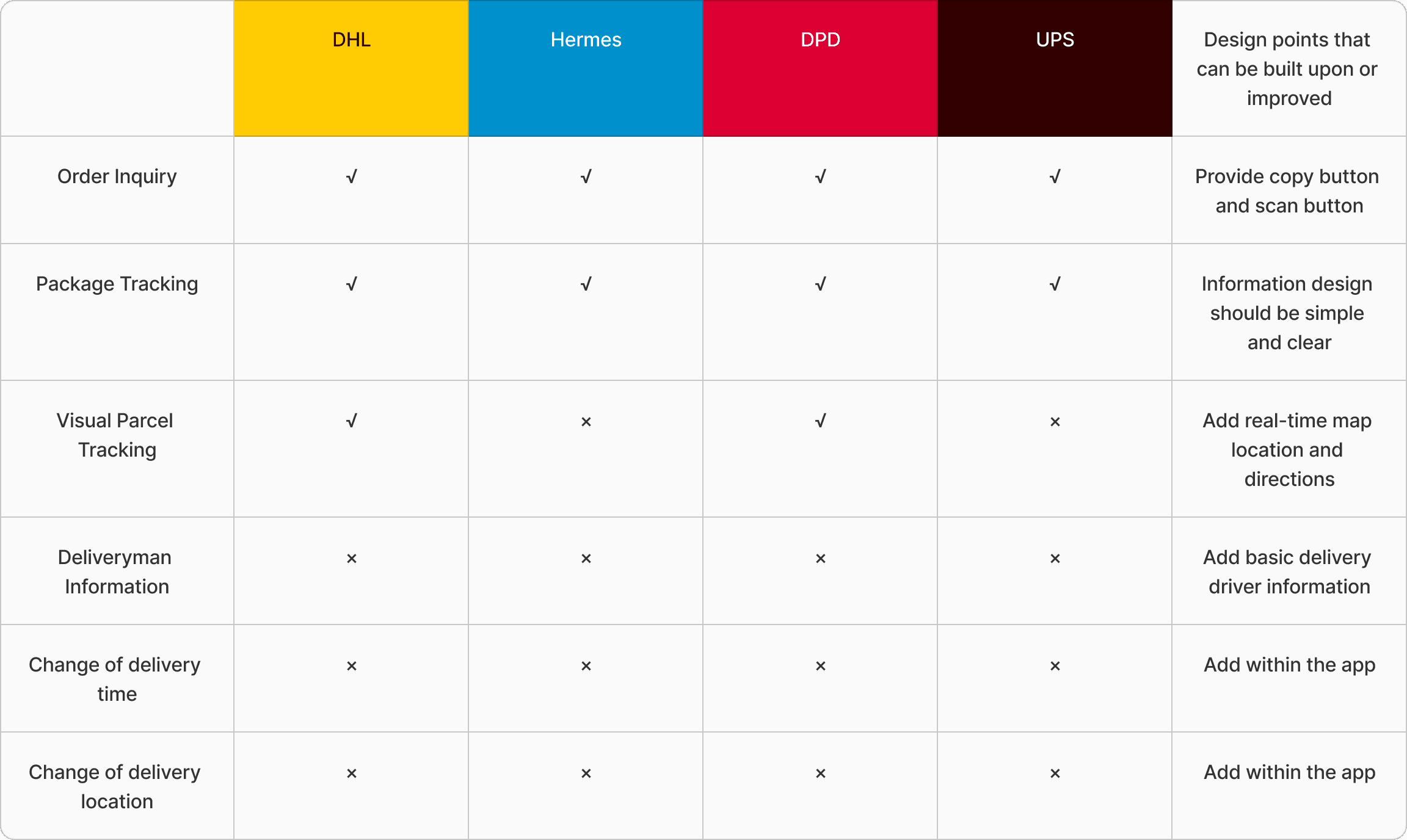
Before diving into the design, I did a competitor analysis to understand the current strengths and weaknesses of UPS and what features are missing.
As of 2022, UPS has the third largest market share (in terms of number of parcels) in Germany, behind DHL and Hermes. dPD and UPS are close to fourth in terms of market share. Therefore, DHL, Hermes and DPD are direct competitors of UPS in the German market. I will also choose these three companies to analyse, focusing on their mobile apps.

This is the parcel enquiry process on the mobile phone mobile terminals of the four companies. After comparison, it is found that there is not much difference in the parcel enquiry process of the four companies. The differences only exist in the page layout, information and colour usage of each brand.
Map user journey

Define
Based on the findings from the previous phase, I summarised the user's problem into 6 points and divided the problem into 3 areas: Information Architecture, User flow, Prototype. Each of these areas has a huge impact on the user's experience. By narrowing down the 3 areas of focus, I can begin to address them independently, even if they are interrelated.This helps me scope the work in a concrete way and divide the resources in a logical manner.
Information Architecture
1. No one was home at the time of the UPS delivery.
2. There is too little real-time information about the package, which affects the consumer's mood and experience.
User Flow
3. Users who are in a hurry to use their parcels have to wait until the next working day for delivery because the delivery efficiency is too slow, which affects their life, work, and study.
4. UPS deliverers do not go upstairs to make deliveries and directly drop off cards where no one is home.
Prototype
5. Changing the time and place of delivery requires a web page to complete the operation, which makes delivery cumbersome.
6. Complaints are answered very slowly on the phone and are not resolved.
Ideate
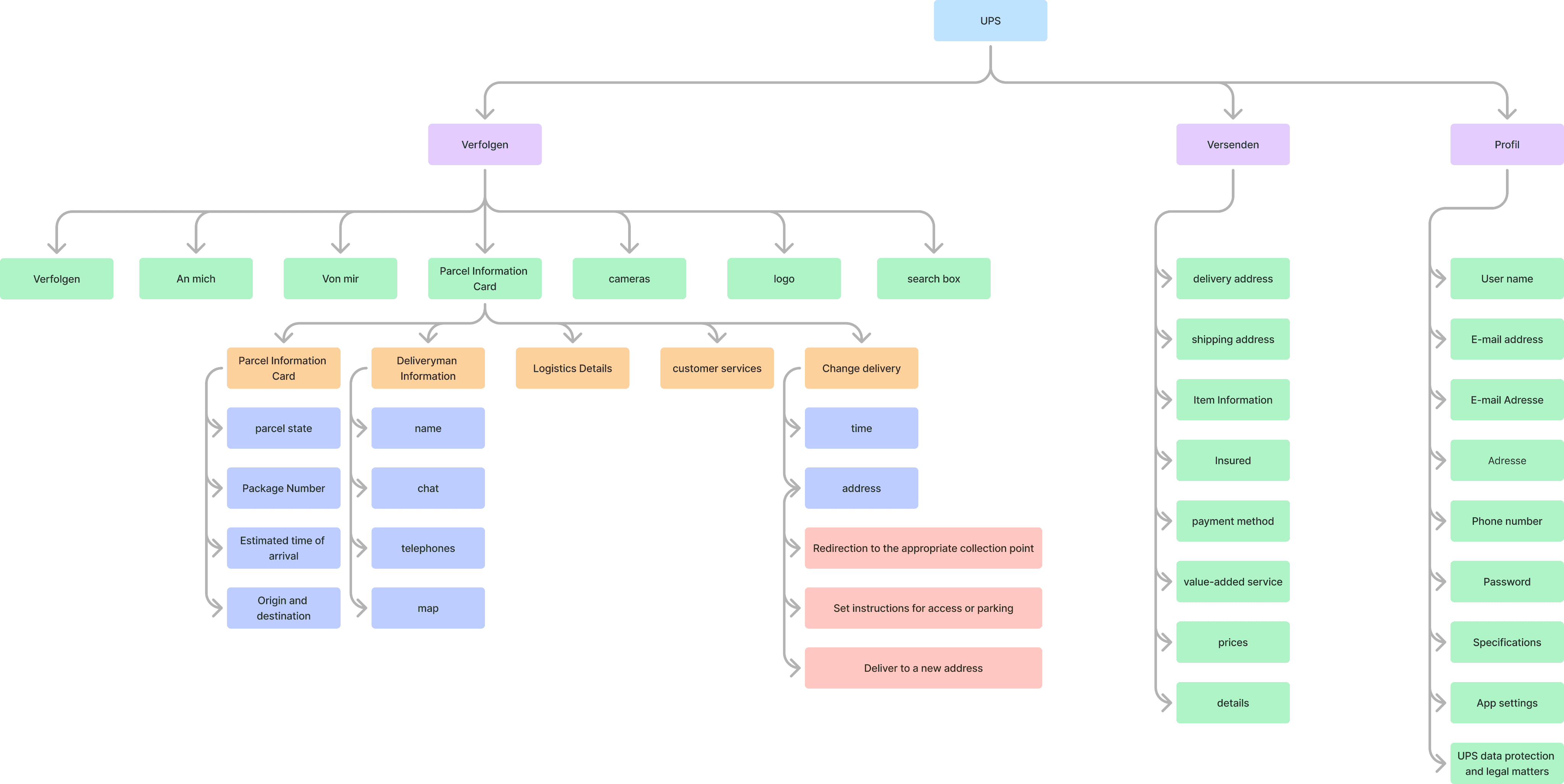
Information Architecture
I've optimised the ‘Verfolgen’ page because it's focused on improving the user experience in the last mile of delivery.
User Flow
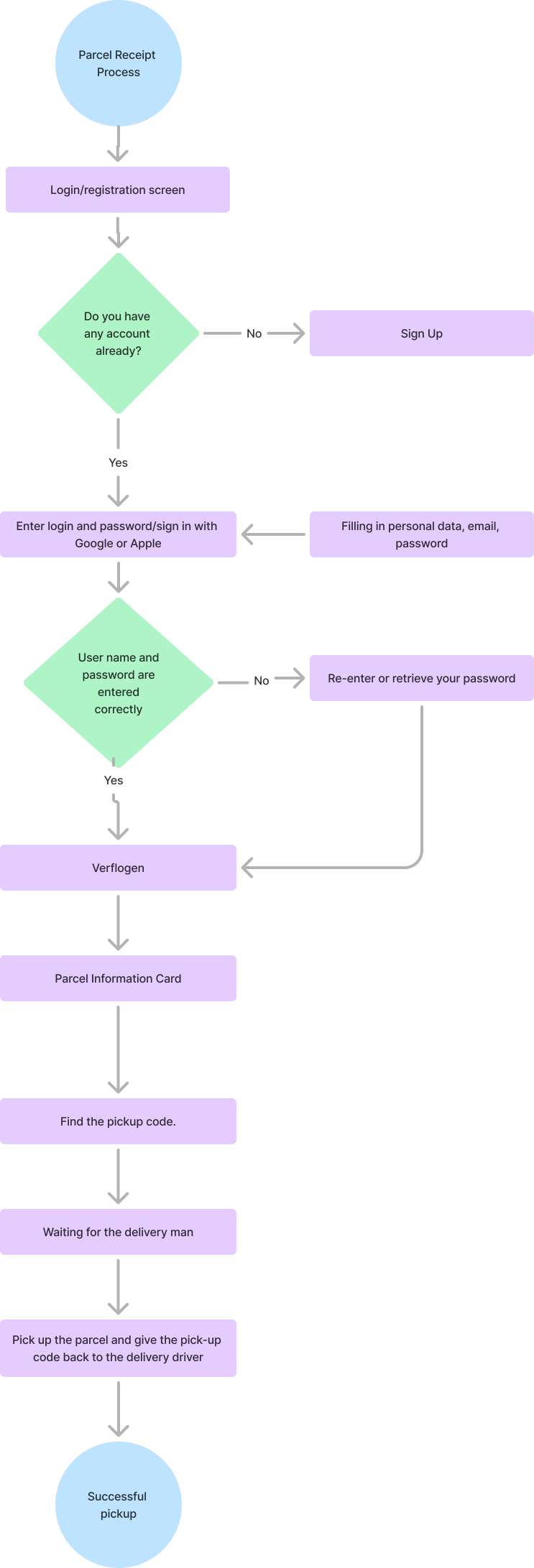
I mainly redesigned three processes for the user: the process of receiving a parcel, the process of contacting the delivery person to pick up the parcel and the process of changing the time and place of delivery.


Wireframe and prototype
Wireframes
Based on the optimisation of the information architecture and User flow, I first drew a low-fidelity prototype to give an initial presentation of my ideas.
20+ wireframes
20+ prototypes
2 rounds of tests
6 participants


Prototypes

New pickup process


New feature to contact the delivery person to pick up the order


Visualize the delivery routes of delivery drivers
Provide users with more flexible pickup options. Reduce the information gap between the user and the delivery person and increase the success rate of delivery.
Provides an interface to chat with the delivery person
Increase the contact information with the delivery person to reduce the situation where the user is unable to receive the goods due to unexpected circumstances. Increase the success rate of delivery.
Function to change delivery time and location

I added a button to change the delivery location and time to the interface, and improved the page for changing the delivery location and time. In the old version, there was no interface for changing the delivery location and time, and users could only click the link in the email to change the delivery location and time.
Other interfaces

Testing
During the user testing phase, I focused on six participants. The tasks of the test were for the participants to complete the receiving process, the change of delivery location and time process, and the contacting the delivery person for early pickup process, respectively. I conducted short interviews after the completion of each task to understand the participants' feelings and suggestions. Participants' behaviours and feedback during the completion of the tasks were also recorded.

Test results
Most of the participants were able to complete all three processes successfully in the test. However, during the test participants raised a question that I overlooked during the design process. The participant asked if contacting the delivery person by phone to pick up the goods would it reveal his or her privacy and that of the delivery person? According to this question I will hide the information about the deliveryman and the user.

Finalize
Results
60%+
Good reviews
(projected)
1100+
Daily users
(projected)
Since this project was my graduation project and had only three months to complete, the final result was not market-oriented. However, based on the data on the market, I expect the new version will increase 60% of positive user feedback and 1100+ users per day than the old version. Users will spend less time waiting for each parcel after using the new version, so they can better balance their life and waiting for parcels; they will have better choices when facing unexpected situations; and they can use the UPS app to do all the operations they want to do.
Room for improvement
Opportunity
The early pickup feature is relatively new and may encounter some issues that have not yet been considered. In order to make this function serve users better, a deliveryman version of the app needs to be designed in the future to better balance the connection between users and deliverymen. To achieve a suitable level of communication and information synchronisation. So that both the deliveryman and the user can complete the process smoothly and comfortably.